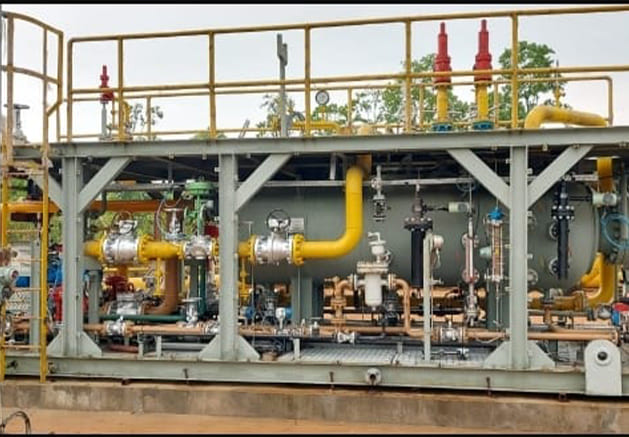
Separators
Crude oil wells contain Gas, oil & water. To optimize field production, Separators perform the primary bulk separation. Multiphase separators are usually the first and most important equipment in the upstream oil production field, with downstream equipment completely dependent on the proper functioning of the separators.
The following types of separators are supplied by Cutter India
i. 2-phase and 3-phase
ii. HP (High Pressure), LP (Low Pressure), IP (Intermediate Pressure)
iii. Test Separator
iv. WOSEP (Water Oil Separator)
v. KOD (Knock-out Drum)
vi. Degasser
A. Technical Details:
i. Vessel orientation
Separators can be horizontally or vertically oriented, depending on plot space and transportation limits. Horizontal vessels are preferred for high liquid capacity and processing capabilities, while vertical vessels are preferred for high gas capacity.
ii. Separator aspect ratio
The aspect ratio of the separator is defined as the ratio of its (L) length or height over its (D) diameter. Typically, the L/D ratio varies between 2.5 and 6 for horizontal separators. However, the L/D ratio depends on specific cases for separation performance and is determined on a case-by-case basis.
iii. Liquid retention time
Liquid retention time, or residence time, is the period during which a liquid phase resides in the separator’s gravity separation zone. While this period can range from 1 to 10 minutes depending on the properties of the liquid and the upstream and downstream variations, normal retention times are from 2 to 5 minutes.
iv. Droplet settling time.
Once the liquid droplet is allowed to settle through a continuous vapor phase, the settling velocity depends on particle size, drag force and densities of the vapor and liquid phases. Droplet velocity is determined by Stoke’s law.
B. Process Description
i. In a separator, the mixture passes through an inlet device to disperse the momentum of the incoming fluids. Primary/bulk separation as well as flow distribution occurs in the inlet section. From the inlet section, the mixture is given adequate settling time to allow the heavier phase to settle beneath the light phase, while the flashed-off gas-phase occupies the free area above the liquids. Additionally, liquid-liquid separation enhancer internals such as plate pack coalescers are added to provide stringent performance guarantees. Liquid levels are maintained by weirs and control valves. A gas-liquid separation device (typically a demisting device) is placed at the outlet section. This device ensures separation of small liquid particles in the gas phase by coalescence. Oil at the specified guaranteed level is discharged at the oil outlet nozzle, while water and gas are discharged through their respective outlets.